
Is Expensive Organic Skincare Worth It? A 2026 Guide

Table of Contents
The Real Cost of Organic Skincare: Price vs. Value
Cost-Per-Use: The Metric That Changes Everything
The Benefits of Organic Skincare: What the Science Says
How to Read Skincare Ingredient Labels Like a Formulator
Is Organic Skincare Better for Sensitive Skin?
Stability, Shelf-Life, and Why Freshness Costs More
Clinical Trial Transparency: What Brands Won't Tell You
When Expensive Organic Skincare Is Worth It (And When It Isn't)
Frequently Asked Questions
Last Updated: October 3, 2026
The Real Cost of Organic Skincare: Price vs. Value
Organic serums often cost several times their conventional equivalents, but price and performance are not automatically linked. This guide from C&C Elegance breaks down what you are paying for, where the premium is justified, and where it is marketing theatre.
The premium typically covers four things: higher-cost raw materials, smaller production runs, third-party certification, and formulation research. Some brands deliver on all four; others charge luxury prices for a pretty bottle and a story.
Organic skincare refers to products formulated primarily with plant-derived ingredients grown without synthetic pesticides or fertilisers, avoiding synthetic chemicals and artificial fragrances. That definition matters because it says nothing about potency, stability, or whether the actives actually reach your skin in a usable form.
Below, we show you how to calculate cost-per-use, read a label like a formulator, and decide when the premium earns its keep.
Cost-Per-Use: The Metric That Changes Everything
A $90 serum used twice daily for two months costs roughly $1.50 per application. A $30 serum that oxidises after three weeks costs more per effective use, because you throw half of it away.
The calculation is simple:
Note the volume in millilitres
Estimate your daily usage (a face serum is typically 2-3 drops, around 0.1ml)
Divide total cost by the number of full doses in the bottle
Adjust downward for any product you abandon before finishing
A common mistake is comparing shelf prices rather than finished-bottle value. The expensive jar that lasts four months often beats the cheap one you replace monthly.
Pro Tip Track your actual usage for one week before buying. Most people overestimate how much product they use, which makes high-concentration formulas far more economical than they first appear.
The Benefits of Organic Skincare: What the Science Says
The documented benefits of organic skincare centre on three areas: reduced exposure to certain synthetic compounds, a lower environmental footprint, and gentler interaction with a compromised skin barrier. Plant-derived antioxidants and botanical extracts can support barrier function without the irritation some synthetic preservative systems trigger, and cold-pressed oils retain more antioxidants than heat-processed alternatives.
Dana Ripperton
What most guides miss is that "organic" says nothing about concentration. A formula can be certified organic and still contain actives at levels too low to do anything measurable, certification covers how ingredients were grown, not how much made it into the bottle.
For a broader look at how regulators treat cosmetic claims, the Therapeutic Goods Administration guidance on cosmetic claims sets out what Australian brands can and cannot legally state.
How to Read Skincare Ingredient Labels Like a Formulator
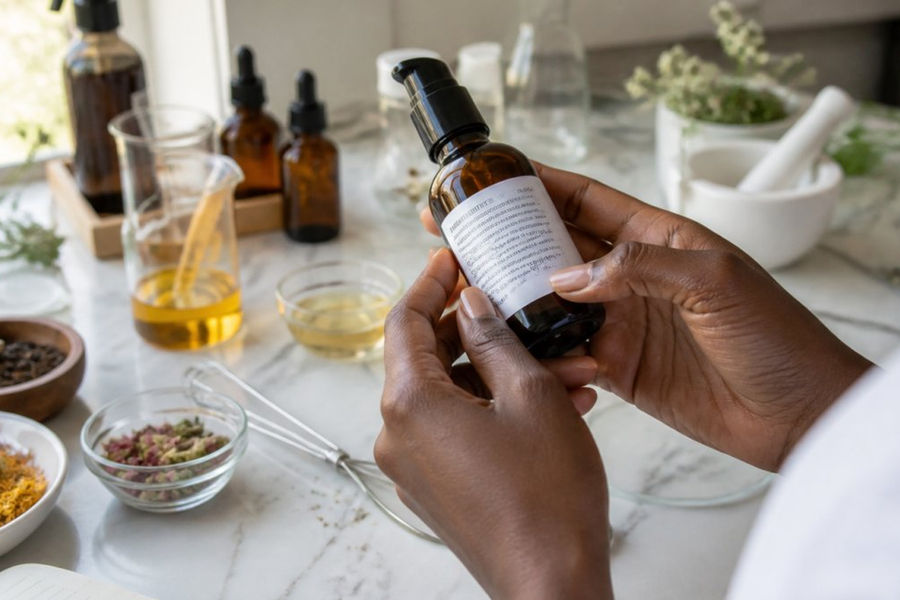
Ingredients appear in descending order of concentration until the 1% mark. Everything after that can be listed in any order the brand chooses, which is where marketing gets creative.
Read a label in this sequence:
First five ingredients, these form the bulk of the formula. If water or a cheap filler leads, the product is mostly base.
Active compounds, look for named botanicals with a stated or implied concentration.
Preservative systems, every water-based product needs one. A preservative-free water-based serum is a microbiological risk, not a selling point.
Fragrance and essential oils, natural does not mean non-irritating. Essential oils are a common trigger for reactive skin.
pH balance, formulas outside the skin's natural range can disrupt the acid mantle.
Watch Out A "preservative-free" claim on a water-based product usually means the brand is relying on an untested workaround or a very short shelf-life. Both carry real risk for sensitive skin.
Is Organic Skincare Better for Sensitive Skin?
For many reactive skin types, yes, but the reason is narrower than the marketing suggests.
What actually triggers reactivity
Reactive skin responds to a small set of well-documented culprits.
A genuinely well-formulated organic product removes several of these at once. That is the real benefit.
The essential-oil trap
This is where the organic premium can backfire. Many certified-organic formulas replace synthetic fragrance with essential oils, a leading cause of allergic contact dermatitis.
If your skin is reactive, the practical rule is: fragrance-free beats naturally fragranced, every time.
What the Australian regulator does and does not control
Cosmetics in Australia are regulated as therapeutic goods only when they make therapeutic claims; otherwise they sit under the industrial chemicals framework.
How to test before you commit
Patch testing remains the only reliable way to know how your skin responds.
If you have combination skin with sensitivity around the eyes, choose fragrance-free formulas and avoid high concentrations of essential oils near the eye area.
Watch Out "Certified organic" and "suitable for sensitive skin" are not the same claim. A formula can carry the strongest organic certification available and still contain essential oils that trigger reactive skin. Read the ingredient list, not the certification logo.
The bottom line for sensitive skin
Stability, Shelf-Life, and Why Freshness Costs More
Formulation stability is the least glamorous and most important factor in whether a product works.
The two shelf-life numbers that matter
Every cosmetic product has two dates. The unopened shelf-life is how long it remains stable before you break the seal.
The PAO determines real value.
The cost of spoilage, quantified
Run the numbers on a $120, 100ml serum with a 6-month PAO.
By contrast, a $60, 30ml serum with a 12-month PAO is fully usable within its window. Effective cost: $2.00 per millilitre.
Pro Tip Before buying, divide the volume by your daily usage to get total applications. Then compare that number against the PAO. If applications exceed what the PAO allows, you are paying for product you will never use.
What stability testing actually involves
A brand that invests in stability testing runs accelerated and real-time studies.
This is expensive and slow.
Packaging is part of the formulation
Opaque or UV-blocking packaging protects light-sensitive actives. Airless pumps limit oxygen exposure and reduce contamination from fingers.
Clear jars are the worst case for any water-based or antioxidant-rich formula. Light and oxygen accelerate degradation, and finger-dipping introduces bacteria.
Preservatives and the freshness myth
Every water-based product needs a preservative system.
Anhydrous products (oils, balms, powders) genuinely do not need preservatives because they contain no water. That is a legitimate formulation choice, not a marketing claim. The distinction matters when you are comparing a water-based serum to a facial oil.
How to use this when you shop
Check the PAO symbol before you buy. Match the volume to your realistic usage over that window.
Clinical Trial Transparency: What Brands Won't Tell You
Very few organic skincare brands publish clinical validation data, and that silence is telling. A genuine clinical trial has a defined protocol, a stated sample size, a control group, and results published regardless of outcome.
When a brand claims "clinically proven," ask three questions:
Proven in what study, with how many participants?
Measured against what control?
Published where, and can I read it?
If the answers are vague, the claim is marketing. Brands with real evidence tend to lead with it.
Key Takeaway The strongest signal of a trustworthy organic brand is not the certification logo. It is whether they will show you their testing data when asked.
When Expensive Organic Skincare Is Worth It (And When It Isn't)
Worth it when: you have reactive or sensitive skin, you value ingredient sourcing and environmental footprint, the brand publishes stability and clinical data, and cost-per-use works out favourably over the life of the bottle.
Not worth it when: the formula is mostly water and filler, actives sit below the 1% line, packaging undermines stability, or the price reflects branding rather than formulation.
Scenario | Premium Justified? | Why |
Sensitive, reactive skin | Yes | Fewer irritants, gentler preservative systems |
Clear jars, water-based actives | No | Potency degrades quickly after opening |
Published clinical data | Yes | Verifiable efficacy, not just claims |
Essential-oil heavy formulas | Depends | Natural fragrance still triggers reactions |
Large volume, short period-after-opening | No | Poor cost-per-use, wasted product |
At C&C Elegance, every formulation is developed under the guidance of Dr. Chantal B, whose PhD background in cancer research informs a rigorous approach to ingredient purity and formulation stability. The range is 100% plant-derived, vegan, and cruelty-free, and free from synthetic chemicals and artificial fragrances, which is the practical difference for skin that has reacted badly to conventional products before.
Deciding whether expensive organic skincare earns its place in your routine is a question of evidence: does the brand show you its data, does the formula hold up over months, and does cost-per-use make sense for your skin. C&C Elegance answers those questions with PhD-led formulation, high-purity active botanicals, and clean, vegan, cruelty-free ingredients free from synthetic chemicals and artificial fragrances. Shop All and build a routine that rewards the investment.
Frequently Asked Questions
What are the benefits of using organic skincare over synthetic alternatives?
Organic skincare often uses plant-derived active compounds and botanical extracts that can support skin barrier function and provide antioxidant properties. Many formulations avoid synthetic ingredients that may trigger reactions in sensitive skin. However, 'organic' alone doesn't guarantee effectiveness. Look for products with clinical validation, stable preservative systems, and transparent concentration levels. The benefits depend on formulation quality, not just the organic label.
How can you tell if an organic skincare product is truly high-quality?
Check for third-party testing, clear ingredient sourcing details, and evidence of formulation stability testing. A high-quality product will list active compound concentrations and explain its preservative system. Be wary of vague marketing buzzwords like 'clean beauty' without supporting data. Also assess product shelf-life and packaging that protects against light and air exposure, which degrade botanical extracts.
Does 'natural' always mean better for sensitive skin types?
No. Natural essential oils and botanical extracts can cause irritation or allergic reactions in sensitive skin. Some synthetic ingredients are actually gentler and more hypoallergenic. What matters is the specific formulation, pH balance, and whether the product has been patch tested. If you have sensitive skin, introduce new products gradually and check for comedogenic ratings on oils.
Why do premium organic skincare products command a higher price point?
Higher prices often reflect the cost of high-purity active botanicals, cold-pressed extraction methods, sustainable ingredient sourcing, and clinical validation testing. Small-batch production and preservative systems that maintain product shelf-life without harsh chemicals also add cost. However, price alone doesn't guarantee quality. Calculate cost-effectiveness by dividing price by number of uses to compare products fairly.
Shop All



Comments